Showing posts with label Sem8.Marketing Management-Strategic Marketing Planning. Show all posts
Showing posts with label Sem8.Marketing Management-Strategic Marketing Planning. Show all posts
-
The scope of marketing. Key elements of marketing strategy.
What is Marketing?
TEACHER: Hello, Student. We are now beginning our discussion on marketing. And I will begin by giving you the official definition.
STUDENT: Hi, Teacher. Do you seriously mean that there is an "official" definition of what marketing is?
TEACHER: Well, at least there is one coming from a very authoritative source, the American Marketing Association (AMA). According to this institution, marketing is "the process of planning and executing the conception, pricing, promotion, and distribution of ideas, goods, and services to create exchanges that satisfy individual and organizational goals."
STUDENT: This is a broad definition indeed!
TEACHER: Certainly it is, because it takes into account all parties involved in the marketing effort:
* members of the organization that produces goods or services,
* resellers of the goods and services (such as stores), and
* customers or clients.
STUDENT: I am noticing that marketing activities may be carried out by diverse organizations; a car manufacturer, a health insurer, a consumer goods company, and on and on and on.
TEACHER: This is very true. Of course the way marketing is carried out varies very much according to the type of organization, but basically most if not all organizations implement some type of marketing plan. Commercial firms market specific products, and also often they market the company itself. And this is certainly not limited to commercial firms; non-profit institutions, government agencies and political organizations conduct marketing activities.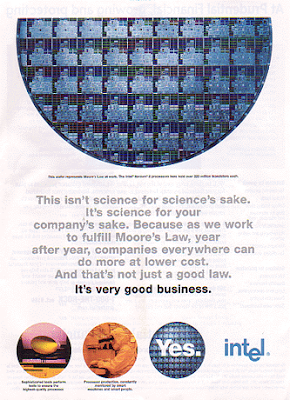 Figure 1
Figure 1 shows and ad from Intel that does not refer to any particular product, but is targeted to improve the image of the corporation as a whole.In Figure 2 we see and ad from the government of Bermuda targeted to motivate tourists to visit the country. Figure 2
STUDENT: The definition of marketing from the AMA you quoted is quite good to explain what marketing is; but what is marketing about? In other words, what is the objective of marketing?
TEACHER: If you pay attention to the definition, you will see that the answer to your query is right there. Notice the words "to create exchanges". This is the objective of marketing.
The objective of marketing is to create exchanges.
An exchange is a process in which two or more parties voluntarily provide something of value to each other. If you purchase a watch, you get a product you value, and the store and the manufacturer get something they value: money. Figure 3Vacances en Campagne, the advertiser in Figure 3, hopes consumers with a sophisticated taste (and some money to spend, too) will be willing to exchange some of their money for the pleasure and prestige of a vacation in a rented villa in France. If this actually happens, the marketing effort (and the exchange) has succeeded.
STUDENT: Nice example, but I am a little envious of those people who vacation in a rented villa in France. I am lucky if I can afford a cheap hotel at a beach a few miles away from my home. Anyway, you made your point. But, when we talk about marketing, we assume there is something called "market". What is a market, exactly?
What is a market?
TEACHER: Exchanges take place within a market. In this sense, a market consists of the individuals and organizations with the desire and ability to purchase a particular good or service. Thus, a given market may consist of organizational buyers, consumers, or both.
Organizational buyers purchase goods and services in order to produce something else to sell. McDonald’s buys meat and bread to make sandwiches, Ford buys steel to produce cars, etc.
Consumers are individuals who buy goods and services for themselves or their households to use; a TV to watch, a car to drive, a vacation to enjoy, a haircut to look nice.
Purpose of Marketing
Successful marketing is customer driven: it addresses customer needs and desires.
Of course the border between needs and desires is not very clear. Also, a need or a desire can be satisfied in very different ways. If you are hungry you might get a hamburger or a meal at a fancy restaurant. To keep warm in winter you could purchase a cheap coat or an expensive one from a famous fashion house.
One of the basic tasks of a marketer is to translate a common need into a specific desire, usually the desire to purchase whatever he or she are marketing.
Figure 4 shows an ad seeking to translate a general need (owning a bed to sleep on) into the specific desire to own the TEMPUR-PEDIC bed. Figure 4
There is no doubt that it is essential that marketing addresses customer’s needs and desires. But in attempting this goal, sometimes marketers make mistakes. A classic example is the famous case of Coca Cola changing the formula of the traditional beverage, based on extensive market research including blind tests by many consumer panels. As a result of these tests, marketers felt that they would better address consumer’s desires with the new formula. The rest is history; outraged consumers forced the company to go back to the old traditional formula.
STUDENT: Why do you think the consumers rejected the New Coke when so many blind tests with consumer panels showed that people liked the new formula more than the old one?
TEACHER: Possibly the key mistake was to rely only on customer’s taste buds and not taking into consideration the emotional or psychological factor. People associate traditional Coke with a lot of memories; in blind tests they may have preferred the new formula, but when being aware that they were drinking a beverage different from the one they felt emotionally close to, they rejected it.
The Quality Approach To Marketing
Marketers in general are concerned about the quality of the goods and services sold by the organizations they work for. Obviously it is complicated to sell poor quality goods or services; the better the quality, the easier the job of the marketer becomes.
Many firms have taken their interest in quality a step or two further by embracing total quality management (TQM). "TQM is a organization-wide commitment to satisfying customers by continuously improving every business process involved in delivering goods or services." Instead of merely correcting defects when they are identified, organizations that practice TQM commit employees to continually look for ways to do things better so that problems won't arise in the first place.
TQM And Customer Satisfaction. At an organization that practices TQM every employee takes the attitude that the people who receive his or her service should be satisfied with them.
STUDENT: Maybe its an exaggeration, but I heard that some businesses even say that customer satisfaction is not a high enough objective; they say TQM should aim to delight customers
TEACHER: Since there is a lot of competition in today’s markets, customers who are satisfied with our products or services today may no by so happy a in few months or weeks, when comparing them with our competitor’s improved offerings. This is why satisfying customers (or delighting them if you prefer) requires not only doing one's current job well, but individually and jointly looking for ways to improve work processes.
STUDENT: Is this what in the jargon of TQM is called "continuous improvement"? Is it true that the Japanese invented it?
TEACHER: Well, the philosophy underlying continuous improvement is the Japanese notion of kaizen: if you do the little things right, the total gain will be enormous.
One way in which organizations can encourage continuous improvement is to invite -and use- employee suggestions. For example, teams at Toyota generate almost three million ideas a year and management implements 85 percent of them.
STUDENT: I know of a least a US company that used this practice as long as 40 years ago. My father used to work for IBM in the and always tells me about how IBM benefited from its employees ideas. And the employees were generously rewarded for their ideas when successfully implemented.
TEACHER: It is said that actually most innovative Japanese business practices were copied by them from IBM, and much later copied from the Japanese by the rest of the world. And there may be some truth in this belief. Bu let’s go on.
The "customer" of a particular employee may not be the ultimate customer of the organization . For example, the Information Technology people give information to the company’s employees, not to buyers of the organization's products.
However, delivering useful information at a reasonable cost helps in the effort to please the organizations customers.
Thus, when all employees strive for high quality, ultimately the organizations customers should be pleased with the results.
STUDENT: What you are saying is that TQM is "a system for integrating quality technologies into various functional departments (engineering, production, sales, service) to achieve customer satisfaction."
TEACHER: Right. Well summarized, Student. Because marketers serve as an important link with the organization's customers (identifying them, learning their wants and needs, communicating how the organization's products can help meet those needs) marketers have an especially important role to play in TQM. For example, they can have an enormous impact on customer satisfaction by seeing that customers' experiences with salespeople are positive and that the specifications developed for the organization's goods and services meet customer demands. When the organization provides services, marketers can see to it that the service providers are well trained in marketing and communications skills that will help them satisfy customers.
STUDENT: Now, is there real proof that TQM is effective, or is it just another of business world’s fashionable words?
TEACHER: Total quality management has the potential to improve the performance of the marketing group and the organization as a whole. A study by the U.S. General Accounting Office found that at organizations using TQM, sales per employee increased 8.6 percent, and customer satisfaction rose. Black & Decker credits its TQM effort with improved product performance, more efficient ordering procedures, and major cost savings, among other benefits.
However, other evidence shows that many organizations are disappointed with their attempts at TQM. Florida Power & Light developed an extensive -and costly- quality program, but its customers saw only minor improvements in the quality of its services. To avoid disappointment, organizations that try using TQM need to remember two important points.
* First, achieving measurable results from TQM (such as improved sales or profits) takes time. Because TQM is based on continuous improvement, it is an ongoing process, not a quick fix. Organizations that reap benefits from TQM usually do so by advancing gradually, adjusting their strategy as they improve.
* The second important point about TQM is that marketing and management efforts must focus on the customer, not on the organization itself.
STUDENT: And how are employees themselves affected by TQM?
TEACHER: Total quality management extends beyond the product and the marketing of the product: it includes an emphasis on quality people and quality processes as well. For employees to be willing and able to continuously improve what they do, they need more than an annual performance appraisal. They need to be empowered.
STUDENT: In what sense to you use the word "empower"?
TEACHER: This means involving employees in decisions about their own workplace, and the organization as a whole. Employees also must have the power to carry out the improvements they see a need for and to take the actions that will satisfy customers.
STUDENT: But it actually proven that empowering employees is effective?
TEACHER: Very few, if any, business practices are universally accepted. Some companies have tried empowering employees and did not find it effective. But maybe these firms did not do things right. Advocates of employee empowerment believe that to participate fully in a business, employees at all levels need four things: power, information, knowledge and rewards.
I had an interesting personal experience. Once I rented a car from Avis and did not notice that the gas tank was not full until I had left the premises. When I returned the car with a full tank I mentioned the problem to the clerk, not expecting any refund but just to help Avis to improve their service. I was surprised when the clerk said: "You don’t have to pay for that gas. I will give you a credit for the gas and for the inconvenience." And so she did; obviously that lady was empowered to take this type of decisions.
As you can imagine, this experience influenced my car renting decisions from that day on.
Levels Of Activity
At times marketers may focus on broad marketing activities. They consider the way an entire marketing system works or should work. At other times marketers are interested in the ways individual organizations carry out marketing and how they can improve these efforts.
Macromarketing - One level at which marketing activities take place is that of the overall economy of a country or a region.
STUDENT: Can you give me some examples?
TEACHER: Gladly. Measuring the overall demand for new cars and trucks is a macromarketing activity. We can also mention the study of aggregate consumption patterns, the evolution of consumers’ tastes, etc.
In a capitalist economy the macromarketing system is based on a market-driven approach. Buyers "vote with their wallets" to determine which goods and services will be produced simply by purchasing the goods and services that they want. In these type of economies buyers can choose from among many makers and sellers.
STUDENT: I guess marketers are very happy that this is so; in monopoly situations the need for marketing people is very low.
TEACHER: Of course. In a "seller’s market", when the seller is a monopoly or when there is a long-term scarcity of a specific good, marketing people are few and not highly paid. Conversely in a "buyers market" where many seller compete and there is ample supply of a product and its substitutes, marketing people are in high demand.
Micromarketing -Micromarketing is concerned with individual organizations. For example, Unilever´s activities directed to make Knorr soups and Hellmann’s mayonnaise varieties and sauces that appeal to a massive consumer market is micromarketing, which includes product design, distribution channels, advertising, etc.
STUDENT: Basically then, marketing consists in promoting sales and advertising, right?
TEACHER: This is a common error. Marketing is much more that that. Depending on the type of business, it may include many other activities such as:
* Product development
* Forecasting
* Selling and
* Logistics (transporting, storing)
Target Markets
The portion of the market to which a firm attempts to sell a specific product is called the target market. As a rather obvious example we can mention that the target market for Procter & Gamble’s disposable diapers are parents with small children. Can you think of some other example yourself?
STUDENT: I can think of Toshiba considering medium and high level executives the target market of its high end portable computer models.
TEACHER: Good.
The Marketing Mix
A marketing mix is "the mix of controllable marketing variables that a firm uses to pursue the desired level of sales in the target market".
The marketing mix consists of four elements: product. pricing, channels of distribution (placement), and communication (promotion).
STUDENT: Yes, I recall that these elements are often called the "four P's" (for product, pricing, placement, and promotion).
TEACHER: Exactly. Let’s discuss each one of the "P’s".
* PRODUCT –Includes the physical product (or service) as well as, for the former, the sizes, packaging, and labeling.
* PRICING -Pricing is the function of setting prices that support the organizations marketing strategy. The price of a product depends partially on production costs, but many other factor intervene: the target market’s personal income level, direct competition of the same or very similar products, indirect competition of substitute products, etc.
* DISTRIBUTION –A basic duty of marketers is to plan how to get the product to the target market so that it will be convenient to buy. This element of the marketing mix is called channels of distribution (or placement).
STUDENT: I assume this includes a variety of activities such as transportation, warehousing, and inventory control.
TEACHER: Right. It is essential that goods and services are readily available to buyers. Distribution is critical to a successful marketing strategy. A firm may have a good product, conveniently priced for the target market, and well promoted; but consumers will not buy it if it isn't readily available to them.
* PROMOTION – (Communications) Informing target markets about the company and its products is the basic objective of a firm’s communication with the public. Activities included are:
* Advertising
* Selling
* Sales promotions (coupons, special offers)
* Merchandising (placing the products attractively at the point of sale)
And now, Student, questions are awaiting you!
more


-
Economic, political, legal, social and technological environment.
The Marketing EnvironmentTEACHER: Hi, Student. We will begin this Module (and some upcoming ones) with a basic description of a successful global company with a strong marketing activity. We shall begin with Unilever, the British/Dutch conglomerate. I am sure you are familiar with one or more of their brands, no matter what part of the world you live in.
 At Unilever employees are dedicated to meeting the everyday needs of people everywhere. The company provides washing powder, shampoo and toothpaste, teas, ice cream, convenience foods, oils and spreads for consumers all over the world. Unilever is one of the world’s leading suppliers of fast-moving consumer goods.Needs of People
 Meeting the Everyday
Everywhere
Unilever’s portfolio of leading brands includes Magnum ice cream, Dove, Omo, Flora, Hellmann's mayonnaise, Lipton tea and Knorr – brands which are known and trusted by millions of consumers around the world.
As traditional structures and lifestyles around the world are being rapidly transformed, Unilever not only responds to consumers’ needs but anticipates future demands. Here are some highlights from the two differentiated types of products - Foods, and Home & Personal Care.
Foods
Unilever Bestfoods' strength lies in its ability to tailor products to different markets and anticipate consumer demands. This requires an in-depth understanding of the countries in which Unilever operates; to this end the company has a policy of listening to its customers. The acquisition of Bestfoods in 2000 brought Unilever leadership in the culinary category. Knorr is now the firm’s biggest brand, with €2.3 billion sales in over 100 countries and a product range covering soups, bouillons, sauces, noodles and complete meals.
Unilever is the number one producer of frozen foods in Europe, under the Findus brand in Italy, Bird’s Eye brand in the UK, and Iglo brand in other European countries.
Home and Personal Care
In much of the world, Unilever leads the Home Care market, which includes cleansing and hygiene products. Many of the firm’s products are market leaders and include Ala, Brilhante, Cif, Comfort, Domestos, Omo, Skip and Snuggle.
Within the Personal Care market, the company is a global leader in products for skin cleansing, deodorants and antiperspirants. Global core brands include Axe, Dove, Lux, Pond's, Rexona and Sunsilk. Innovation is paramount within the Home and Personal Care markets in order to maintain Unilever’s strong market position.
STUDENT: That is a good idea, Teacher. It is interesting to hear about the world’s leading marketers. I guess you will tell me something about the challenges encountered by this type of companies in developing and implementing their global strategy.
The Marketing Environment
TEACHER: Certainly. At Unilever, as in most other companies, managers have had to plan for and contend with a variety of laws, changing economic conditions, and strong competition. These and other external forces are important to marketing in all kinds of organizations. Together, they constitute the marketing environment: the economic, political, legal, social, institutional, technological, and competitive factors that affect an organization's marketing effort.
STUDENT: Is there some logical classification of the elements of the marketing environment?
TEACHER: Indeed. We could say that the main elements can be categorized as follows:
* The economic environment
* The political and legal environment
* The social environment
* The institutional environment, and
* The competitive environment
Environmental Scanning
Environmental Scanning consists in keeping track of external changes that can affect markets. Can you think of some examples?
STUDENT: I guess economic, legal and technological conditions, as well as aggregate demand are important factors to be watched.
TEACHER: Right. Among many others, of course. Through environmental scanning, marketers identify ways to act promptly on new opportunities and cope with new challenges. They learn more about their customers' needs and their competitors' strengths and weaknesses. Therefore, before marketers can create a plan, they need to know about the marketing environment.
Contents Of Environmental Scanning
Environmental scanning seeks to identify trends that offer opportunities or can change the market for goods and services. It answers questions about specific markets, such as:
What does the average family look like?
How often does this average family eat out?
What laws are likely to affect the firm's choice of packaging?
STUDENT: I noticed you said "specific markets". Why the emphasis?
TEACHER: Few organizations today can afford to limit their view of the marketing environment to the country in which they are based. Many organizations have customers in at least a few other parts of the world other than their home countries. Even organizations that market only in their home countries are likely to have foreign competitors. Thus, modern marketers need to take a global view of the marketing environment.
The economic environment
In general, the economic environment for marketing comprises the overall economy, including business cycles, consumer income, and spending patterns.
Business Cycles And Spending Patterns - Simply put, marketers want to know whether their target markets will be willing and able to spend money. Spending patterns are linked to the business cycle, the level of business activity that moves from prosperity to recession to recovery.
Prosperity - During times of prosperity, production and employment are high. Consumers demand more goods and services, and they spend freely not only on basics but on luxuries such as vacations, designer clothing, and entertainment. In addition, they may upgrade big-ticket items such as housing and cars. They are also more likely to travel overseas (except in times of foreign political unrest).
Can you guess how marketers react when there is prosperity in one of their target markets?
STUDENT: I know that consumers in prosperous times often want the "best" of everything and are willing to pay for it. I have experienced a bit of prosperity myself in the past, and I guess I am a typical consumer. And I noticed that marketers introduced new products, increased their promotional efforts, and raised prices in order to increase profits.
TEACHER: I guess you didn’t like the latter, but it’s a fact of life; if marketers notice that you have more money, they want some of it and usually get it. Competition permitting, that is.
Inflation - A rise in the overall price level can occur at any stage in the business cycle, but it is typically most pronounced during periods of prosperity. During inflation, rising prices reduce the amount of goods and services that can be purchased with each dollar, euro, or whatever the local currency is. This is a problem for consumers and organizational buyers if their income does not keep pace with the rate of inflation. In addition, inflation can affect marketing strategy. For example, it can make purchasing on credit more appealing because customers will make payments in a currency that is worth less than it was at the time of purchase. Also, pricing strategies must be developed with care to avoid alienating customers with repeated price hikes to cover rising production costs.
Recession - During a recession, production decreases and unemployment generally rises; consumers fold their wallets and snap their purses closed. Reduced production and decreased consumer demand lead organizational buyers to reduce their consumption as well. Both types of buyers stick to purchasing the basics and look for the best value for their money.
STUDENT: Is everyone affected negatively by a recession?
TEACHER: Not everyone. Marketers of private-label (store brand) and generic goods may find they have an edge by offering brand-name quality at less than brand-name prices. Resourceful and creative marketers can prosper during a recession; if more people carry their own meals to work instead of eating at restaurants, grocery companies may offer ready-made, easy-to-carry lunch and dinner foods, such as these "Pasta Cups". Recovery - While the economy is in the recovery stage, progressing from recession to prosperity, the level of production increases and unemployment decreases. Consumers and organizational buyers have more money to spend but may still be reluctant to increase their purchases. They recall the recent recession and are wary of another slump. Consumers may try harder to save and buy few items on credit. As the economy becomes stronger, buyers begin to relax and spend more freely.
The perception of economic recovery can have just as much influence on spending patterns as the reality.
Resources - Spending patterns are tied not only to business cycles; they may also be related to the availability of certain resources. Resources may be in short supply because demand for a product exceeds a manufacturer's capacity to produce it.
When the supply is limited in these and other ways, marketers may engage in demarketing, an effort to reduce demand for a product. A common use of demarketing is the effort by many electric utilities to provide their customers with tips on how to save energy: insulate their home, use fans instead of air conditioners, install more efficient lighting. Not only do these demarketing efforts help bring demand under control, they may enhance the utility's public image as an organization concerned about the environment.
Consumer Income - Although business cycles reflect the overall health of the economy, the income of individual households determines whether or not consumers can -and will- buy products.
Marketers are interested in three measures of consumer income:
* gross income,
* disposable income, and
* discretionary income.
Gross Income - The total amount of money earned in one year by an individual or household is that person's or household's gross income.
Besides showing trends over time, measures of gross income help marketers divide the market into various income groups. Organizations may be interested in targeting consumers at certain income levels.
Disposable Income Disposable income is the money an individual or household has left after paying taxes. Obviously, tax rates directly affect disposable income: lower taxes mean more disposable income.
When some expenses rise or fall, people shift the way they spend their remaining disposable income. For example, as energy prices rise, people must spend more of their disposable income on gasoline, heating fuel, electricity, and so forth. This leaves less income for other expenses.
STUDENT: I have also noticed that when purchasing certain high priced goods becomes easier, the demand for many consumer goods falls. As an example, if there is a fall in interest rates to finance new homes, more people will commit a substantial part of their income to monthly mortgage payments, leaving less disposable income to purchase say designer clothing, restaurant meals, etc.
TEACHER: Right, as you will see right now, the process you describe has to do with a reduction in "discretionary income".
Discretionary Income - The money consumers have left to spend after paying taxes and living expenses is called discretionary income. The distinction between disposable and discretionary income is somewhat arbitrary because what one person views as a luxury may be a necessity to another. The transition from needs to desires comes into play here: a consumer may need transportation, but the marketer must convince the consumer that he or she wants a car -and a certain make and model at that.
Or you may need a vacation, but Carnival’s marketers will try to convince you that what you want is a Caribbean cruise.
In general, discretionary income pays for vacations, hobbies, entertainment, designer clothing, jewelry, television and music, home decorations and furnishings, gifts, and the like. In other words, discretionary income pays for all the extras.
The political and legal environment
Business doesn't function strictly by its own set of rules. It has to answer not only to its customers but also to the federal, state, and local governments, which set the rules in the political-legal environment. This dimension of the marketing environment includes laws, regulations, and social pressures affecting marketers. Typically these require organizations to compete fairly and in a manner that doesn't hurt consumers.
Laws and regulations cover many areas relevant to marketers, including packaging, pricing, advertising, and sales to minors. The extensiveness of laws and regulations can make marketing complex.
Self-Regulation - In many industries, organizations have recognized that they have more control over their operations if they regulate themselves well enough that voters and legislators will not step in and set limits. To regulate themselves, organizations use industry groups to set and enforce standards.
Influences On Laws And Regulations - Of course, the legislators and regulators who develop laws and regulations are influenced by outside forces. Primary sources of influence in the political/legal sphere include lobbyists and consumer interest groups.
Political And Legal Factors In The Global Environment - International marketers are affected by agreements between countries and by the laws in every country in which they operate. Perhaps the most vital political and legal factors in the global environment are international trade agreements. For example, the North American Free Trade Agreement is designed to drop trade barriers among Canada, the United States, and Mexico through such means as the elimination of tariffs, or taxes paid on goods imported from the nations participating in the agreement. Similar objectives were behind the establishment of free trade within the European nations that formed the European Community.
The social environment
The social environment of marketing is made up of potential or existing customers of the organization. Marketers describe this environment in terms of who the people are (their ages, incomes, hometowns, and so forth) and what values they hold. Changes in the social environment, whether subtle or dramatic, can present marketers with new opportunities and challenges.
Demographic Trends - To describe the social environment, marketers begin with basic demographic data. Demographics is the study of the characteristics of a human population. These characteristics include age, birth rate, death rate, marital status, education, religious affiliation, ethnic background, immigration, geographical distribution, and so forth.
Marketers use demographics to analyze their markets, learn about customers, and satisfy those customers. Pinpointing changes or trends in the population is vital to marketing strategy.
Culture: Values And Language - Of course, demographic data alone do not tell marketers enough about potential customers. For example, it is not enough to know how many retirees are in an area. A marketer for a museum would also want information such as what these people like to do with their time and whether they like to learn new things. One way marketers get more information is to study the values of cultures and subcultures. Cultural values are the principles, qualities, or beliefs that members of a culture consider desirable.
It is known that many people are against the generation of electricity by nuclear reactors. Marketers of the Nuclear Energy Institute, an industry group, published this add to convince members of the public that nuclear energy is desirable.
While cultural values may seem abstract, they have a direct relationship to marketing.
When serving foreign markets, marketers must be aware that every society has its own values.
Language - In communicating across national borders, the language barrier is a cultural factor that poses a great challenge. Mistakes when developing product names or advertisements can be downright embarrassing. A classic example is the marketing in Latin America of GM's Nova, which in Spanish means "doesn’t go.'
STUDENT: This happened many years ago and I have heard this example many times.
TEACHER: In spite of the frequency with which this example is cited, marketers are still making mistakes. For instance, a company marketing tomato paste in the Middle East discovered that in Arabic, "tomato paste" translated to the not-so-appealing "tomato glue," and in Spain Chrysler translated the advertising slogan "Dart Is Power" into a phrase that implied buyers were seeking but lacking in sexual vigor.
The institutional environment
Many organizations that produce goods and services rely on other organizations to help make those products available to customers. For example, automakers need a network of dealers to sell their cars to consumers, and they need trucks and ships to carry the cars to the dealers. They also may work with a variety of other outside experts who handle such marketing activities as advertising and marketing research. Organizations that handle these activities are broadly defined as "marketing intermediaries,' and they and their activities make up the institutional environment. The major players in the institutional environment are resellers, physical distribution firms, marketing services agencies, and financial intermediaries.
Resellers - Stores such as supermarkets or department stores are one type of resellers. Marketers also use resellers to make goods and services available to organizational buyers and independent distributors who will purchase the goods in bulk and sell them to many other resellers..
In scanning the environment, marketers seek to learn about the resellers already operating. Marketers are interested in which resellers will distribute their products most effectively, be willing to carry their products, and be able to work with their suppliers.
Marketing Services Agencies - The organizations that provide marketing services include marketing research firms, advertising agencies, media firms, and marketing consulting firms. These organizations can help the marketer select target markets and implement an effective marketing strategy. The marketer needs to keep track of what services are available and which agencies are best skilled in providing the services needed. Thus, part of environmental scanning includes periodic performance reviews of marketing services agencies.
Financial Intermediaries - Carrying out marketing activities requires money. Therefore, the organization's success may depend in part on the availability of funding from such financial intermediaries as banks, credit companies, and insurance companies. For businesses, the major lenders in the United States used to be banks. Today, however, over three-quarters of business loans come from other institutions, including life insurers, brokerage firms, and finance companies . If the cost of credit goes up or its availability shrinks, the marketer's plans may be in jeopardy. Thus, even if handling financing is not the marketer's direct responsibility, marketers must be aware of financial conditions.
The technological environment - Scientific knowledge, research, inventions, and innovations that result in new or improved goods and services all make up the technological environment of marketing. Technological developments provide important opportunities to organizations that can use them to meet customer needs. For example, advances in manufacturing technology have enabled businesses to adopt "flexible manufacturing," meeting precise needs with short production runs. As a result, small manufacturers can now enter markets, that were once too expensive to serve .
STUDENT: Let me add "printing on demand" as a good example. You can now order a hardcopy book and the publisher will print a single copy for you and send it by mail within 24 hours.
TEACHER: Correct. No need to print thousands of copies and store them until readers buy them.
When the organization fails to keep up with technological change, technology becomes a threat. IBM's dominance of the market for large mainframe computers did not spare the company from posting a huge loss when customers found they could get all the computing power they needed from smaller computers . To succeed in an industry so volatile, computer makers try to innovate continually.
STUDENT: When their products incorporate new technology, marketers must try to create demand for them.
TEACHER: Yes. In the mid-1980s, marketers had to, convince record buyers to switch over to CDs. The superior quality of the products themselves -better sound, greater longevity- helped bring consumers around. Also, as fewer records were manufactured, consumers had to make a change. Technological developments continued, and manufacturers introduced minidisks and digital compact cassettes. Again they needed to build demand for their new products.
Keeping up with technological developments is especially important for marketers who serve business customers. These buyers may rely on technological innovations for their very survival in a competitive marketplace. Familiarity with modern technology helps marketers develop products that meet new needs or meet the old needs better.
The Competitive Environment
It is extremely rare for an organization to be the sole supplier of a particular good or service. Therefore, marketers must find out what their competitors are doing and predict what they might do in the future. These activities concern the competitive environment the organizations that could potentially satisfy the needs and desires of the organization's target markets. In scanning the competitive environment, marketers must remember to consider existing or potential competition from foreign as well as local organizations.
Types Of Competition - The nature of the competitive environment depends in part on the type of competition that occurs there. Economists describe four main types of competition: pure competition, imperfect competition, oligopoly, and monopoly.
Pure competition (also called perfect competition) occurs when similar products are offered, buyers and sellers are familiar with the market, and both buyers and sellers can easily enter the market.
Examples include the markets for farm goods and forestry products.
STUDENT: There isn’t a lot of room here for what is normally called "marketing", is there? Like advertising and promotion.
TEACHER: Partially true. In this form of competition, marketers compete almost entirely on the basis of price.
The most common form of competition is "imperfect competition", which occurs when there are many sellers of a product and each has a relatively small market share. Marketers must find ways to distinguish their products from the similar ones offered by competitors.
Oligopoly occurs when products are similar and a few sellers control most of the market. Examples are air travel and long-distance telephone service, but also many branded consumer goods are marketed in an oligopoly environment.
STUDENT: The reason for this type of situation is that the industries you mentioned have high start-up costs, I suppose. Let me add Intel and AMD, the computer chips manufacturers, to your list of typical oligopolies. In the case of branded consumer goods, the reason must be the very high cost of making a brand popular enough to command a large portion of the market.
TEACHER: Correct. And in some cases, a single entity maintains a monopoly on a product; that is, it is the only organization selling the good or service. A monopoly organization has great control over the prices it charges. However, monopolies are rare in advanced economies except when run by the state itself.
Until the government ordered its breakup into smaller units, AT&T had a monopoly on the telephone communications market in the United States. Likewise, electric utilities once held monopolies in the regions they served, but now a federal law permits independent power producers to send electricity over the big utilities' transmission lines. This allows the (often cheaper) independents to break the monopolies. Some products enjoy temporary monopolies (as in the case of a drug with patent protection) or most of the market share (as has Gatorade for years, recently holding 90 percent of the market for sports drinks).
Competitive Forces - Given that most organizations have at least a few competitors, marketers must consider how these competitors can affect the organization. For example, perhaps a new company will begin marketing a competing product, as in the case of a new maker of personal computers based on Intel chips. Or perhaps an organization will begin marketing new goods or services that take away sales from an existing product, as CD players drove down sales of record turntables. One way to evaluate the competitive forces affecting organizations is to categorize them into five types: rivalry among existing competitors, threat of new entrants, threat of substitute products, bargaining power of suppliers, and bargaining power of buyers .
Rivalry Among Existing Competitors - To develop a successful marketing strategy for a product, a marketer needs to be aware of existing competitors. Who are the major competitors? What are their annual sales? How much of the market do they
control? What are their strengths and weaknesses? What are their marketing strategies? With answers to such questions, a marketer can draw customers away from competitors through superior strategies for pricing, advertising, sales promotion, customer service, and other activities.
Threat Of New Entrants - Unless the government forbids it, there is always a possibility that a new competitor will enter the market for a product. The threat of new entrants is especially great when an earlier companies success signals a demand for its product.
Some markets are easier to enter than others. Barriers to entry might include a need for heavy financial investment or years of experience to reduce the cost of production. For instance, the start-up cost for a new automobile manufacturer would be a lot higher than that for a restaurant. Industries with low entry barriers are more likely to have new entrants and, thus, more competitors.
Threat Of Substitute Products - Broadly speaking, all sellers in an industry are competing with sellers who offer substitute products. Some substitutes are very similar, like tee vs. coffee or orange vs. apple juice. In other cases the substitutes are not so similar but can still take away sales from a given product.
Bargaining Power Of Suppliers - Suppliers are a key competitive force because they can determine the price or quality of parts or raw materials. When a few suppliers control a large share of the market, as in an oligopoly, buyers may have to accept a high price.
However, more and more organizations today are looking for suppliers willing to work closely with them, in a form of partnership, to improve quality and reduce production costs.
Bargaining Power Of Buyers - Buyers can force prices down, bargain for higher quality or more services, and set competitors against each other. Whereas a small buyer may have to live with a price increase from a supplier, a large buyer may have
the clout to request a lower price. Buyers also can purchase a firm that supplies them or purchase another firm within the supplier's industry.
Competition In The Global Environment - Like Unilever, many large companies have striven to enter the global market. While American firms are aggressively entering foreign markets, so foreign companies provide stiff competition in the United States. The most notable example is the competition that Japanese cars have given to the American auto industry. Since the 1970s, well-to-do consumers have steered their car purchases toward Japanese makes. And nearly half of Americans interviewed in a 1991 Gallup Poll said Japanese auto manufacturers were "the most likely to come out with technological innovations. However, thanks in part to a quality focus and the efficiencies of cross-functional teams. American cars are on the road to a comeback. General Motors' introduction of the Saturn, with its emphasis on quality in product, process, and people, signaled a turnaround for the American auto industry, or at least for GM.
more


-
Ethical issues in marketing
TEACHER: Hello, Student. Who do you think a business is responsible to?
STUDENT: Hi, Teacher. Well, I know that many maintain that the primary responsibility of a business is to earn profits for its shareholders. But I am sure there is something hidden in your question, isn’t there?
TEACHER: Yes there is. First of all, the marketing concept adds that a business should do this (earning profits for its shareholders) by meeting the needs of its customers.
But nowadays the prevailing view is that the organization's responsibilities extend even further, to include social responsibility -an organization’s acceptance that it is accountable to society for its actions. Thus, a business is responsible not only to shareholders, but also to customers, employees, others in its marketing channel, society and the earth's environment.
STUDENT: To show you that I am well informed, let me tell you that I know that these groups -other than the shareholders- are called "stakeholders", because they have a stake in the business.
TEACHER: Very well, Student. You have been reading lately, I see. But the question is....
Why Be Socially Responsible? Proponents of social responsibility typically argue that this behavior is to the organization's best interests in the long run. Potential customers, so the argument goes, will be in the best position to buy if the organization looks after their welfare as individuals and community members. And in these times of stiff competition, potential customers who have trouble choosing from among competing products may well buy from the company they most respect.
Responsibility To The Community
Social responsibility to the community can take two forms: ceasing negative activity, such as pollution, or taking a positive action, such as starting an education program that benefits the community.
In the add below, the Shell Oil Company stresses its commitment to plans and programs to help protect the ecosystem, as well as to other socially responsible programs; "with leadership comes responsibility", the add says. Positive action may also consist of consumer education, partnerships with schools or teachers' organizations, or funding for special projects.
Here again we can use the example of Shell: the add below publicizes Shell’s contribution to the preservation of "Endangered Historic Places" in the USA. STUDENT: Can we define the project described in the ad above as a "Community Relations Project"?
TEACHER: Certainly, it fits into the definition of "projects undertaken out of social responsibility that not only benefit the community, but also enhance community relations, reinforcing a positive image of the organization.
We shall also mention...
Cause-Related Marketing - Some organizations undertake cause-related marketing (CRM), a formal version of marketing on behalf of the community. With CRM, charitable donations are tied directly to the sales of a specific product, or to the use of a specific credit card, or to making purchases at a given supermarket.
STUDENT: I guess CRM must be popular among marketers because it sets up a win-win situation. The product or service is promoted, and profits and sales are increased.
TEACHER: True. Also, customers are satisfied, members of the community benefit from the donations made, and community relations are enhanced.
Global Social Responsibility - Being a responsible member of the community can be more complex for an organization that operates in more than one country. The organization needs to know what the community expects or wants and must find a way to meet those expectations. In spite of the difficulties, the increasing global presence of multinational companies is leading them to make more of their contributions in other countries. Alcoa worked with local officials in southern Brazil to build a sewage plant. IBM donated computer expertise and equipment to the National Parks Foundation of Costa Rica to develop strategies to preserve rain forests.
Responsibility To The Environment
With consumers increasingly voicing concern about the environment, marketers have found it necessary, and often profitable, to make environmental consciousness part of their social responsibility efforts.
STUDENT: Are you talking about "Green marketing"?
TEACHER: Exactly. Green marketing can benefit the marketing organization in various ways. But basically because it appeals to the values of more and more people. Not only do many consumers feel better buying a product that is supposed to be environmentally friendly, but they also have more respect and are more willing to buy products from companies considered to be respectful of the environment.
Take a look at this add from Honda, and notice that while the main approach is to stress how Honda’s Low Emission Vehicles respect the environment, it is also emphasized that Honda "has a commitment with clean air since 1975"; i.e., Honda has a long history of being friendly to the environment. Green Marketing And The Quality Approach - Green marketing is a natural extension of the quality approach to marketing. According to Helen 0. Petrauskas, vice president of Environmental and Safety Engineering at Ford Motor Company, customers' demand for "green" products and "green" organizations will eventually surpass the strictest regulatory standards. In other words, marketers who want to satisfy their customers will have to do more than simply meet environmental standards imposed by the government.
Please take a look at this add from Ford, Student. Would you care to comment? STUDENT: I can see that Ford’s ad confirms that green marketing is a natural extension of the quality approach to marketing, as you said before. The company defines itself as being not just a good company, but as a "great one" because it not only delivers "excellent products and services" but also "strives to make the world a better place".
TEACHER: Exactly. Ford does not elaborate on what exactly their contribution to improving the world is, but the message is clear.
STUDENT: Is there any research available on the effect of "green marketing" on prices?
TEACHER: In general, green marketers have learned that making a product friendly to the environment does not mean they can charge a higher price. According to a study by Syracuse University's School of Public Communications, 93 percent of adults said a product's environmental impact was important to them in making purchase decisions, but two-thirds said environmentally friendly products should not cost more .
But I can tell you of at least one example when making "concentrated" detergents that require less packaging and less energy to ship has also turned out to be more profitable. One reason for this is that the difficulty of comparing regular with concentrated detergents make it almost impossible to shop by price. Also, consumers tend to run big loads of laundry and pour in generous amounts of detergent; the little measuring scoop included in the package just doesn't look like enough in spite of the manufacturer's recommendations.
Ethical Issues
The wide acceptance of social responsibility is based in part on the view that it is in the organization's best interests. What do you think, Student?
STUDENT: I suspect that in real life there is not always such an ideal situation.
TEACHER: Right you are. Consider the following responses to an informal poll of a management magazine’s readers : "It's naive to believe anybody can be successful and totally ethical." "Often what we do is not what we would like to do." Many business questions are more a matter of survival than ethics." "Ethics are defined by the situation. Therefore, good judgment is paramount!'
Marketers and other businesspeople often struggle with the solutions to ethical problems. Ethics are the moral principles and values that govern the way an individual or group conducts its activities. Marketing ethics are the principles, values, and standards of conduct followed by marketers.
STUDENT: And why isn’t it obvious that marketers should behave ethically? Why are these issues so difficult?
TEACHER: One reason is that ethical standards vary from one person to another. And sometimes the only available courses of action contain a blend of hurtful and helpful actions. Even when people agree on what is the most ethical course of action, that alternative may seem unduly costly -especially to the owner of a start-up company with little cash or to the employee trying to hold onto a job.
STUDENT: I see. I also assume that operating in a global marketplace makes ethical issues even more complicated. Marketers must be attuned to the values not only of mainstream society in their home countries, but also of the other cultures in which they hope to market their products.
TEACHER: There are many difficulties, but yet ethical principles are important for marketers from both a moral and a business standpoint. In the words of Scott Cook, founder of a Menlo Park, California, software company called Intuit, "Being truthful is good business." In the long run, I may add.
Social Criticisms Of Marketing
Public perception of businesspeople has always been negative, and the Enron, WorldCom, Arthur Andersen and many other incidents have not improved this perception.
Marketers reinforce this view whenever they bend the rules, favoring a quick sale over a long-term relationship.
Society wants marketers to adhere to its values, beliefs, and principles. As these have become more complicated, criticism of business practices has grown more strident. Add issues of legality to the pot, and the result is a rather spicy stew. Care to comment, Student?
STUDENT: I can imagine that by obeying the law, the marketer can avoid actions that have legal penalties. But not all legal behavior is ethical; it would be impossible to write enough laws to require ethics in all business dealings.
TEACHER: Right. And at the same time, an action that a marketer considers ethical might violate the law. For example, a marketer might think that customers would benefit from an arrangement with several competitors to avoid price increases, but this arrangement likely would violate antitrust laws.
Ethics And The Marketing Mix
Ethical issues arise with regard to all the elements of the marketing mix: the product itself, its price, its channels of distribution, and its marketing communications.
Ethics And Product Development - Perhaps the largest ethical issue related to products is their quality. A common complaint about product quality is planned obsolescence. Obsolescence refers to products wearing out or becoming obsolete. Planned obsolescence means the producer built the products not to last, at least not as long as buyers would like to use them. From the marketers point of view, if some of these goods were made more durable, they might have to be priced beyond the reach of most buyers.
Furthermore, today’s rapidly changing technology makes it hard to find a product that can meet the demand for state-of-the-art goods. Can you think of the obvious example, Student?
STUDENT: Computers, of course, Teacher. They are a notable example of products that are obsolete by changing technology long before they wear out.
TEACHER: Very good. Further ethical issues arise with regard to packaging. The use of large packages, designed to use more shelf space or to make the consumer believe that the package contains more of the product than that of the competitor, is a common but questionable practice. Odd-shaped bottles or boxes that appear to contain more are common.
STUDENT: Is misleading packaging unethical or an acceptable way to remain competitive?
TEACHER: A good question, to which I don’t have an answer!
Especially in the areas of food and cosmetics, labeling has become a battleground for competing marketers. Terms such as 'Lite," "Low Fat," "Reduced Calories," and "Natural" do not guarantee nutritious ingredients. Even fresh products such as apples may be injected or sprayed with chemicals to make them look more appealing or long-lasting.
STUDENT: I also notice that many cosmetics claim to have "anti-aging" effects, and common sense tells me that this claims are dubious at best. Is it the responsibility of the marketer to present accurate information on labels or of the customer to confirm marketers' claims?
TEACHER: You keep making these good questions, Student, to which I do not have good answers! But I can tell you that it is fair to assume that consumers have the right to honest information about products so that they can be responsible buyers. A company that practices quality marketing can present the product attractively without offering misleading information.
Ethics And Channels Of Distribution - In quality marketing, the relationship between a manufacturer and its resellers is vital. A high standard of ethics is important to this relationship, which at its most successful creates a team, or even a partnership.
STUDENT: I have a few questions here. Is it ethical for a fast-food franchiser to require that all outlets purchase their food and supplies from the parent company as condition of the franchise agreement? Is it ethical for a big brand-name manufacturer to refuse to supply its products to a store that doesn't want to display them in a certain way?
TEACHER: Good questions again, Student. You keep making them, and I must keep not answering them! But let me try: in the particular cases you mentioned, ethical or not, these are common practices wherever not prohibited by law.
Ethics And Communication – The case of false or exaggerated claims about a product is clearly unethical. Other unethical practices (which may be illegal as well) include bribes, kickbacks, and "bait and switch" advertising.
STUDENT: What is "bait and switch?"
TEACHER: It consists in advertising that a product is for sale at a low price, then claiming that it is unavailable and offering a higher-priced item when customers seek to buy it.
STUDENT: Some businesspersons use the term "caveat emptor" to express how they feel the relationship with their customers should be. I know it’s Latin, but what does it mean exactly?
TEACHER: It means "buyer beware." In other words, buyers were considered responsible for evaluating the quality of merchandise, truthfulness of promises, and so on; if something was wrong, it was up to the buyer to find out before completing a transaction. This concept is not widely accepted now as it was a few decades ago.
STUDENT: And what about the "B" word?
TEACHER: If you are referring to bribery, the prevailing standard in most developed economies is that bribery is unethical. Nevertheless, in many industries organizational buyers are tempted with lavish gifts. Of course, buying from whichever supplier produces tickets to the most exciting sports event is hardly likely to serve the buying organization's best interests.
STUDENT: Yes, but in some parts of the world, bribery is prevalent, even customary.
TEACHER: Sure. The U.S. Congress has passed the Foreign Corrupt Practices Act. This law makes it illegal for American companies to bribe a foreign government official or agency in order to do business in that country. But while this behavior is now illegal, it may still be expected by foreign governments or businesses.
STUDENT: And it surely puts American companies in some disadvantage when competing with companies based in Europe or Asia that do not have this type of restrictions.
TEACHER: Yes, that can be presumed.
Organizational Codes Of Ethics
Many organizations, concluding they must take a formal stand requiring ethical behavior by their employees, have established a code of ethics. Such a code is a written statement of the organization's ethical principles and standards of conduct. These codes usually cover confidentiality, conflicts of interest, relationships with other organizations in the marketing channel (such as the propriety of giving gifts to buyers of the company's services), payments to government officials (say, to speed up bureaucratic processes), and other areas.
Recognizing the importance of ethical codes in marketing, the American Marketing Association (AMA) established its own written code of ethics, that provides guidelines for ethical behavior in the areas of marketers' responsibilities, honesty and fairness, the exchange process (including the marketing mix), and organizational relationships.
Diversity
Today the diversity of the population in most countries is greater than ever. Immigrants continue to arrive from all parts of the globe, speaking many different languages and bringing different values.
People tend to prefer the company of others like themselves, however, and various forms of discrimination persist. Fortunately, many marketers do realize that narrow-mindedness is not only unethical but against their best interests. Marketers and other businesspeople today must recognize the existence and benefits of the populations diversity. Above all, they must appreciate the diversity of the markets they serve and of the work force they participate in.
Issues of diversity are closely tied to issues of ethics and social responsibility. Ethical considerations and many times also laws require fairness in hiring, promotion, and compensation practices. Organizations with operations overseas must contend with the ethical dilemma of how to extend fairness to countries with different, often lower, standards for environmental protection and treatment of workers.
Diversity Among Markets
The United States as well as the global marketplace is full of variety. Language, cultural norms and values, geographical location, age, sex, and levels of income and education are just a few of the ways in which people differ. These differences are among the information that marketers should gather through environmental scanning, described in Module II.
STUDENT: So, the conclusion is that diversity is a big problem, right?
TEACHER: I’d rather say its a reality and definitely a challenge, but it also has benefits. Organizations can benefit when their marketing staff and outside marketing experts reflect the diversity of the markets they serve. A diverse work force brings a variety of insights and strengths that can add creativity to decision making and problem solving. In addition, when marketers are diverse, they can best recognize and interpret the needs of more of the population and tailor the features the marketing mix to such variables as where and when people shop, how they perceive price discounts, and where they will see or hear advertisements.
And this will be all for this Module, Student. See you soon!
more


-
Marketing in the Global Environment
TEACHER: Hi, Student. Again, we will begin this Module with a basic description of a successful global company with a strong marketing activity.
Johnson & Johnson has $36.3 billion in sales and is the world's most comprehensive and broadly based manufacturer of health care products, as well as a provider of related services, for the consumer, pharmaceutical, and medical devices and diagnostics markets. Johnson & Johnson has approximately 108,300 employees and more than 200 operating companies in 54 countries around the world, selling products in more than 175 countries. Around half of Johnson & Johnson's sales are to customers outside the United States. We can see in the picture above that J&J shows a worker with Asian features possibly to stress that the company has employees of diverse races.
But in contrast we have the following picture taken from the J&J Japanese Website for ACUVUE contact lenses. Student, please tell me what you think about this illustration.
STUDENT: Well, there is some text written in Japanese, but I notice that the people used as models do not look Japanese, and as far I can see, the packaging is mostly in English.
TEACHER: Right. We do not know the reason why J&J marketers decided to use non-Japanese looking people as models, but it is intriguing, isn’t it?
Like Johnson & Johnson, many organizations have found that they can benefit from taking an active role beyond the borders of their home country. Roughly two-thirds of the Coca-Cola Company's revenues come from non-US. operations.
The major difference between marketing globally and marketing within a company’s home country is the complexity of the environment. We’ll take a look at the many issues marketers must consider when entering a foreign market.
STUDENT: Interesting, but what about companies that have no plans for marketing outside their home markets?
TEACHER: When scanning the marketing environment, marketers need to take a global view. Even when the organization does not have immediate plans to do business outside their home country, marketers need to recognize the business opportunities and threats emerging elsewhere.
The Global Economy
Today the prevailing view is to think of almost any country as part of a global economy. The actions of consumers and businesses, especially in large economic units, affect other nations.
This notion of a global economy is not entirely new. In the 1920s economists observed that the Western nations had similar business cycles. In other words, prosperity and recession were occurring at roughly the same time in the United States and in the European countries, and their major trading partners elsewhere in the world.
STUDENT: Sure. And in the 30s, a series of competitive protectionist measures worsened the world-wide depression; each country "exported" its depression to the rest, in a vicious circle damaging for all trading nations.
TEACHER: Very good observation. Since then, various trends have linked the nations' economies more tightly than ever. One such trend is advances and improvements in the economic infrastructure in many nations. Economic infrastructure refers to a country's facilities available for conducting business activities, especially the communication, transportation, distribution, and financial systems.
As a result of the advances in economic infrastructure, businesspeople can move goods, deliver services, transfer funds, and transmit messages faster and more widely than ever before. Distance has become much less of a barrier to doing business.
Main Trading Blocks And Nations
North American Free Trade Agreement - Marketing efforts among Canada Mexico, and the United States have grown fast since the three countries signed the North American Free Trade Agreement (NAFTA). This international agreement phases out tariffs and other trade barriers among the three nations, creating what many call the world's largest common market. Besides lifting trade barriers for goods, NAFTA helps service providers serve the three countries by ending requirements that professionals be citizens of the country in which they practice. Professionals must still comply with any laws regulating how they practice; however. U.S. banks and securities firms can operate Mexican subsidiaries, and U.S. trucking firms can carry international cargo to Mexico.
Critics of NAFTA have warned that the agreement would cause unemployment a U.S. businesses moved their operations to Mexico. Of course, many businesses including such giants as Procter & Gamble, Unilever, Nestlé, PepsiCo, Ford, Chrysler, and General Motors, have already operated in Mexico for decades, a trend that is likely to continue. NAFTA supporters claim that free trade will play a more important role by enhancing Mexico’s prosperity and increasing the demand for US and Canadian products and services.
The European Union (EU)
Together, the gross national products of the members of the EU are second only to that of the United States. Thus, the EU is a major force in the worldwide marketplace. In addition, the strengthened trade among EU member nations is likely to make European businesses tougher global competitors.
STUDENT: I guess that as customers, EU members may be easier to serve, right?
TEACHER: Correct. Uniform product standards mean that products do not have to be modified to comply with the laws of each member nation. For example, all motor vehicles sold in the EU must meet the same standards for pollution and noise emissions. Also, the elimination of border checks between member nations has made it easier to transport goods throughout Europe.
In serving the EC, marketers must remember that the union still consists of individual nations. The European Community has over ten mother tongues, two fundamentally incompatible legal systems, and three major variants of the dominant religion, with Islam making major inroads in France and the United Kingdom.
Japan
When Americans and Europeans think of international competitors, they typically think of Japan. In fact, Japan is not only the second largest exporter to the United States, it is also the second largest importer of U.S. products. Thus, U.S. marketers think of the Japanese as not only potential competitors but also potential customers.
A significant example is the popularity of the Macintosh computer and of Windows software for IBM compatible models, which has stimulated sales of U.S. applications software. The only major segment of the PC software industry dominated by Japanese rather than U.S. firms is Japanese-language word processing -and U.S. vendors have begun to compete there as well.
Other Nations
Asia/Pacific Rim - As more and more mass marketers have recognized, the world’s most populous continent is Asia. Besides Japan, the nations with the most potential purchasing power are China and other countries with especially fast-growing economies -Indonesia, Malaysia, Singapore, Taiwan, and South Korea. The size of the Asian markets alone is enough to endear them to mass marketers.
With more than 20 percent of the world's population, China cannot be ignored by the world's marketers. Not only does this country have well over a billion people, their economic status is accelerating in, according to one report, "one of the biggest improvements in human welfare anywhere at any time".
While the size and growth of China's economy are breathtaking, other Asian economies are expanding as well. Some countries such as Singapore and South Korea seeks technological leadership. South Korea once did so through such Japanese-style practices as investing massive sums to gain a leading position in particular industries. More recently, Korean businesses are seeking partnerships with foreign companies that can teach them useful technologies.
Africa - Another region that is significant in terms of population is Africa, the second most populous continent. Many countries of Africa have middle-class residents and large, modem cities.
Eastern Europe - The nations of the former Soviet Union and its European allies have received much attention in recent years. As these nations have moved toward capitalism, marketers have hoped Eastern Europeans would increasingly demand their goods and services. Many have been pleased to find a welcoming market for their products.
Central and South America - Political upheaval and slow economic growth have in the past dampened marketers' interest in Central and South America. However, there are some signs that these countries have become more attractive markets. They have lifted many restrictions on business and have privatized many government enterprises. Chile has been one of the most attractive South American nations for foreign businesspeople, thanks to two decades of free-market economics and a decade of economic growth. And Brazil has become one of the largest economies in the world; Brazil joined with Argentina, Uruguay and Paraguay to form the Mercosur trade block.
STUDENT: I understand that Mercosur is technically a "Customs Union".
TEACHER: Correct. This means they have a common tariff for all imports from outside the block, obviously higher (or at least equal) than the customs duties for inter-zonal commerce.
As international developments continue to open up opportunities, marketers must be able to evaluate a number of issues that can make global marketing more challenging than domestic marketing.
When marketers identify such issues as differences in economic conditions, laws, and culture, they can identify when and how to tailor their marketing mix to serve target markets in other countries.
Economic Conditions
As noted earlier, the nations' economies are increasingly intertwined, and business cycles tend to follow similar patterns. However, there are differences, and these may be significant. In learning about particular countries, marketers need to find out such basics as the country’s stage of economic development, the buying power of its people, and the strength of its currency.
Currencies - Each nation has its own currency -money that is in general use in that nation. The only important exception is the Eurozone; most EU countries have adopted the Euro as their common currency.
Organizations that handle more than one type of currency must understand and keep up with exchange rates. Exchange rates are continually changing, which creates significant risks for global marketers.
Political And Legal Considerations
The international political and legal environment can affect a marketing strategy in several ways. In assessing a country, marketers need to consider whether its political system creates an acceptable climate for operating there. Relevant dimensions of the legal environment include laws limiting international trade, laws of host countries, and the General Agreement on Tariffs and Trade.
Political Systems - Some political systems favor government control over the freedom of individuals and private organizations. Indonesia, Russia and China are examples of countries with an unfavorable reputation in that aspect.
Another political issue is the country's stability. In the United States, the presidency can change hands as often as every four years, and as a result, policies regarding international trade can shift frequently. But although political leaders come and go, the U. S. system itself has endured the Civil War and shows no signs of ending. In contrast, other political systems, such as several in Latin America, stand on much shakier ground.
Laws Limiting International Trade - Nations seek to protect the interests of domestic businesses by limiting the activities of foreign businesses within their borders. An example is antidumping laws, which are designed to prevent foreign businesses from harming local competitors by selling at less than cost.
STUDENT: Naturally, the problem here is to define "cost". Average cost? Marginal cost? Plant cost?
TEACHER: Of course, in practice every time this legislation is applied, it is in response to strong lobbies. The US applies an antidumping tariff to South American honey. How can the cost of producing honey be calculated?
STUDENT: Well, maybe South American bees earn lower wages!
TEACHER: Very funny indeed. Other common laws related to international trade include import restrictions, exchange controls, limits on who may own or work for the organization, and restrictions based on national security.
Import restrictions may take the form of tariffs and quotas. A tariff is a set of duties charged on imported goods and services. In this sense, duties are taxes on imports or exports. The government may set duties for a type of product at a single rate for all countries, or it may charge different rates to different countries.
STUDENT: Is this why countries want to get a "most favored nation" treatment from other countries?
TEACHER: Correct. Once Country A achieves a "most favorable nation" status, from B, A’s products must always be treated by B as favorably as any other nation’s.
Import quota is a limit on the amount of a product that may be brought into a country. The intent of import restrictions is to give domestic producers an edge within the country. However, they tend to hurt domestic buyers by leading to higher prices.
STUDENT: What are the famous "non-tariff barriers"?
TEACHER: Many countries dodge the trade agreements they have signed by using health and other bureaucratic regulations such as labeling and packaging as excuses to interfere with international commerce, making imports more difficult and expensive.
Exchange controls are laws that place a ceiling on the amount of money that may be exchanged for other currency.
Ownership restrictions may require that a majority of the company’s ownership be in the hands of the host country's citizens. Or a majority of the organization's personnel might have to be citizens of the host country. In that case, the organization has to either restrict its operations to countries with enough qualified personnel or arrange to train its employees to make them qualified.
Some marketers also face restrictions related to national security. If the U.S. government determines that selling a particular product to buyers in certain countries poses a threat to national security, the government may prohibit the sale. This type of restriction particularly affects sales of high-tech products such as computers and communications equipment.
Laws Of Host Nations - Businesses operating in foreign nations must observe those nations' laws. In some cases, business is more regulated in other countries than in the home country. For example, many European nations specify the days and hours during which businesses may operate. In other cases, multinational companies are challenged by being used to a less regulated environment in their home countries. For instance, many countries allow cartels and unregulated monopolies that are prohibited in the United States. In addition, patents and copyrights are better protected in the United States than in many countries,
Sometimes an organization finds that a country’s laws make that country's market too inhospitable to serve. Coca-Cola Company pulled out of India for 16 years because of a requirement that the company disclose the formula for its concentrate. Rather than give away this closely guarded secret, Coca-Cola stayed away until the requirement was removed.
The General Agreement On Tariffs And Trade - The laws and regulations governing international trade can make global marketing more difficult. Yet most governments also recognize that when international trade is easy and widespread, domestic consumers can benefit from wider choices and domestic businesses have access to more customers. These benefits are behind a variety of laws and policies designed to promote free trade.
One of the most important efforts to make international trade easier is the General Agreement on Tariffs and Trade (GATT). GATT is an international framework of rules and principles for opening up trade between member nations, backed by an agency that serves as a forum for negotiations.
STUDENT: The WTO?
TEACHER: The World Trade Organization, correct. Over 100 nations are member nations. Since the first GATT treaty was signed after World War II, tariff negotiations have taken place in several "rounds," and the average size of tariffs has plummeted.
Culture And Language
Marketers need a basic familiarity with the culture of any nation where they intend to operate. Becoming familiar with a culture is not the same as latching on to a few stereotypes and applying them lightly. Rather, marketers should develop a sense of the values and styles of behavior common in various countries so they can recognize cultural differences and work constructively with people of other cultures. Marketers need to know about customs, etiquette, and the dominant religion. Some potential areas of difference to be aware of include family roles, personal space, perception of time, individuality versus group identity, and the degree to which the culture emphasizes achievement or relationships.
Knowledge of and sensitivity to cultural differences can smooth relationships with foreign partners and potential customers. This is especially important for marketing services, because the services marketer typically comes into direct contact with the customer. Thus, a business consultant who repeatedly violates a culture’s rules of etiquette is not going to get many referrals or much repeat business.
Learning about a culture can uncover marketing opportunities. For example, the average German employee gets six weeks of vacation time and more than one holiday a month. This suggests a fertile marketplace for consumer products related to leisure time and for industrial products designed to boost productivity. And German retailers' practice of closing at 1:00 p.m. on Saturdays and all day Sundays has created an opportunity for U.S.-based franchises such as McDonald's, which are open seven days a week.
Culture And Buying Behavior - Marketers need to learn about cultural influences on consumer behavior. The fact that a product was made in the United States impresses people in some countries, but not French or German consumers. In Asia's fast-food arena, KFC benefits from the fact that chicken is consumed worldwide and is not shunned by certain religions, as are pork (by Muslims) and beef (by Hindus). And when it comes to athletic shoes, Japanese consumers like striking color combinations, such as black and gold.
Cultural differences apply not only to consumers but to the practices of businesses and businesspeople. Westerners who want to follow proper etiquette in Asia avoid joking around, wearing flashy clothes, giving lavish gifts, and making physical contact (except to shake an extended hand). In making buying decisions, Japanese businesspeople tend to place more importance on their relationship with the vendor than is common in the West.
Language - An aspect of culture that affects many marketing decisions is language differences. Foreign marketers in Mexico, the U.S. or Japan have to overcome the hurdle of one different language, but other countries make that challenge look simple. China, for example, has a common written language but many different spoken dialects. Indonesia has more than 300 different language groups.
And even groups who speak the same language have important language differences among them. A Spanish word that is perfectly innocent in Spain or Argentina, may be offending in Mexico or Venezuela.
Recognizing the extent of language differences helps marketers realize that they must be careful to understand how consumers in other nations are likely to interpret not only their promotional messages but any communications at all, including brand names. No marketer wants to use a brand that sounds odd to potential buyers' ears. Consider, for example, Sweden's Krapp toilet paper, Japan's Homo salami, Italy's Mukk yogurt, and France's Pschitt soft drink.
Obviously, in general advertisements are written in the local language.
This is an ad from a Japanese company promoting in Argentina a car made in Brazil; the ad’s copy is in Spanish. But the widespread knowledge of English, and the fact that the language carries a certain prestige, motivates marketers to use it in countries where English is not the local language. The following is an ad written in English to sell a Swiss watch in some Latin America’s Spanish speaking countries.
 Ethical Considerations
It seems reasonable to assume that ethics requires fair treatment of employees and customers, whatever their national origin. However, putting this principle into practice can be difficult, in part because different nations may have different standards.
For many marketers, the ethical approach is to apply abroad the ethical standards they adhere to at home. Levi Strauss sets standards for its foreign contractors, such as requiring them to pay at least the prevailing local wage. Whirlpool finds that foreign consumers are eager to buy energy-efficient, water-saving appliances, so its concern for environmental issues pays off globally.
Impact Of Marketing - Marketing a product in another culture can sometimes bring about detrimental changes in the targeted group's cultural practices. Asian cultures have been praised for having diets low in fat, but U.S.-based fast-food chains are introducing Asians to the joys of cheeseburgers and fried chicken.
Producers of infant formulas have been criticized for using promotional practices that have the effect of encouraging new mothers, especially in less developed nations, to opt for bottle-feeding rather than breast-feeding, even though the latter is associated with healthier babies.
STUDENT: Yes, I heard about a "textbook case" when the World Health Organization accused Nestlé of these practices, especially "motivating" pediatricians to recommend bottle-feeding to new mothers. The company yielded to the pressure and abandoned that marketing strategy.
TEACHER: Me may also mention that U.S. tobacco companies have been criticized for aggressive marketing tactics in Asia, where cigarette sales had been concentrated in the hands of government monopolies that did little to promote smoking. In many Asian countries, U.S. cigarettes are now seen as glamorous, and there is much less awareness of their health risks than in the United States. From the perspective of quality-driven marketing, one might criticize all these tactics as being based primarily on the business's profit needs rather than on the needs of the customer.
Exporting
The least risky way to serve foreign markets, is to export the organization's products. Exporting involves producing the product in the organization's own country, then shipping it to another country for sale. Because this approach involves little change to the organization's way of operating, it is a common mechanism for a first attempt at serving foreign markets.
A twist on exporting that is becoming more popular is international mail order. Fast door-to-door deliveries by services such as Federal Express and DHL make it
easy for retailers such as Amazon to have goods shipped worldwide.
Licensing
Some organizations often opt for licensing arrangements. Licensing is granting another organization the rights to use a trademark or a patented product or process. In exchange for these rights, the organization that holds the license pays a fee.
Now, please take a look at this ad, published in Argentina by Grimoldi and Fallabella.
This add is a good example of global marketing and business.
Hush Puppies is a division of Wolverine World Wide, the world’s leading maker of casual, work, and outdoor footwear. Hush Puppies is headquartered in Rockford, Michigan. Grimoldi is the licensee of Hush Puppies for Argentina, but the shoes are mostly manufactured in Brazil. Falabella is a Chilean company that owns a large department store in Buenos Aires, the capital city of Argentina.
A popular form of licensing is franchising, extensively used by large firms like Coca Cola and Pepsi (for bottling and distributing) and McDonald’s (for restaurants). Granting a license carries a risk because the licensor may lose control over how the product is made and how the customer is treated. And when the licensing agreement ends, the licensee may use its newfound expertise to become a tough competitor.
This is not normally the case of the large franchisers such as McDonald’s, which keep a strong control on all franchisees’ actions.
STUDENT: But I know an example of the second comment you made above. One of the few markets where Pepsi was very much ahead of Coke in share was Venezuela. When the franchisee of Pepsi in Venezuela, who operated all bottling and distribution, switched to Coke in a surprise move, the situation was suddenly inverted: Coke became the market leader by far from one day to the next.
TEACHER: Good real life example, another "textbook case". I guess there must be a sign posted now at Pepsi’s headquarters: "Never trust a franchisee!"
Now, let me tell you about the "Chandon strategy" to segment markets, illustrated by this ad. Moët & Chandon is a French company that produces and markets a famous champagne. The company bought wineries in Chile and Argentina and produce "champagne" to be marketed in these countries, where the use of the word champagne is not legally restricted to the produce of the Champagne region of France, as it is in Europe and the US. Naturally, they did not want their cheaper local product to compete in the international market with the French product. On the other hand, using Moët or Chandon as local brand would be much better than using a new, completely different brand name. To solve this problem, Moët & Chandon markets its product in Chile and Argentina under the brand name Chandon, not Moët & Chandon. The company gets the benefit of the well known Chandon name, while preventing that any illegal export of its product could effectively compete with the French produce in third countries.
Joint Ventures
A joint venture is a business agreement in which two or more organizations share management of an enterprise. An organization that wants to enter a foreign market would enter into a joint venture with an organization from the targeted country or with experience operating there. Joint ventures can benefit organizations that are strong in some areas but not others. They seek a partner that has the strengths they lack.
A joint venture gives the organization more control than it would have under a licensing agreement. At the same time, the organization does not have to accumulate as many resources or as much experience as it would without its venture partner. Furthermore, some countries, including India, China and Thailand, encourage the use of joint ventures by requiring that ownership be partly in local hands.
Joint ventures also have drawbacks. The organization may have to compromise its own objectives when they conflict with those of its partner. Also, the organization may share so much information that its partner can become a formidable competitor. According to one report, the proliferation of alliances between U.S. and Asian companies in the computer industry is allowing Asian organizations to obtain technology that would have required an investment of billions of dollars and many years of research.
Direct Ownership
An organization may also own production and/or marketing operations in the foreign countries it serves. Such arrangements, called direct ownership, may involve setting up the necessary facilities or acquiring a foreign firm in the same line of business.
Direct ownership gives the organization maximum control over foreign activities. Setting up operations close at hand may also be a condition of doing business with customers who want fast service. On the downside, direct ownership is expensive. It also requires an ability to handle language, cultural, and other differences. The normal way to gain this expertise is hiring locals to run its foreign operations. Because of the drawbacks, direct ownership tends to be most attractive for large firms and organizations that already have global experience.
As a result of such activities, many marketers today work for foreign-based companies-and many more will tomorrow. Consequently, the most successful marketers of the future will be those with the flexibility and sensitivity required to work with and meet the needs of people from throughout the world.
more


Subscribe to:
Posts (Atom)


